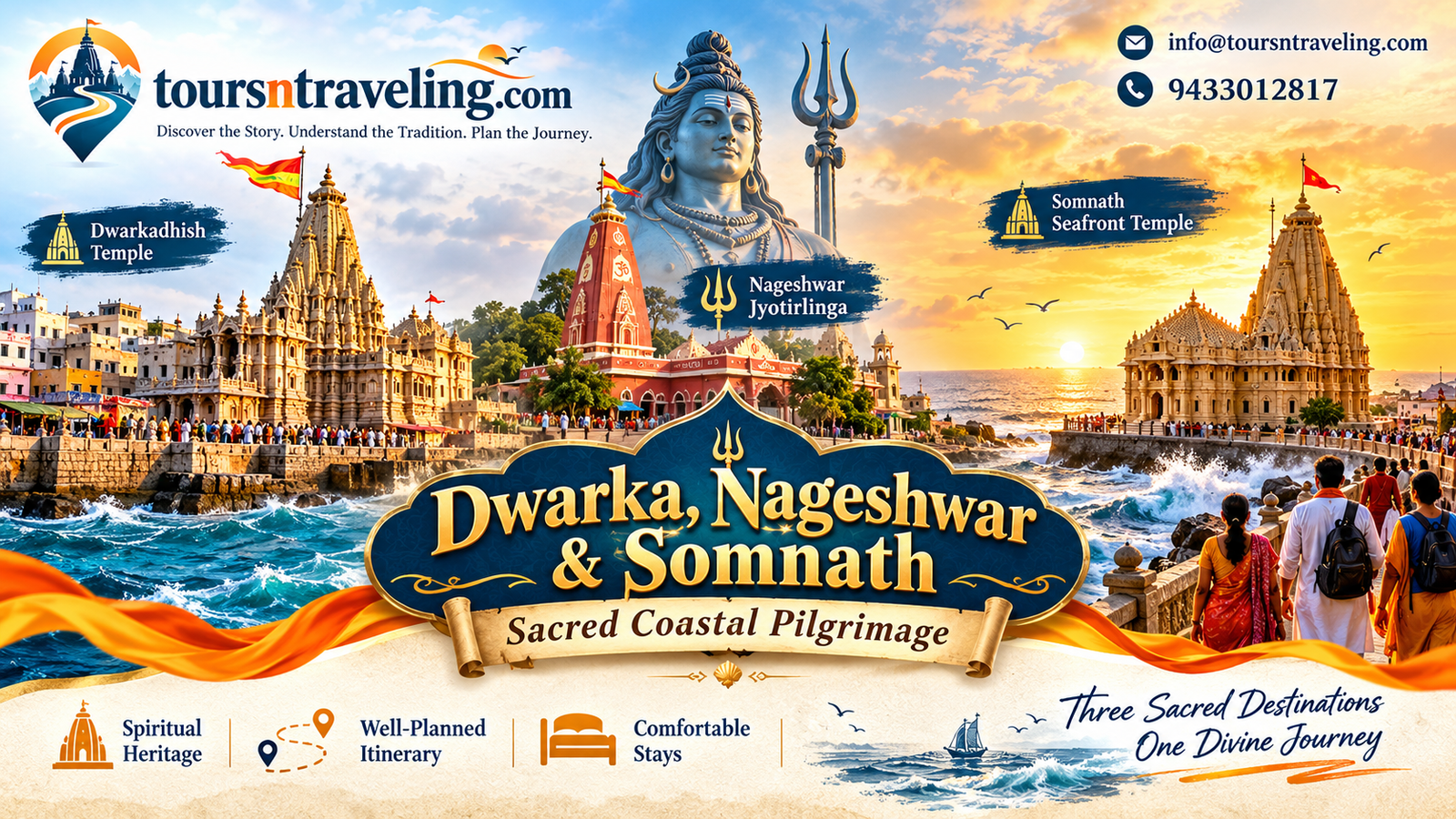
Dwarka, Nageshwar & Somnath pilgrimage tour · conceptual branded illustration
A thoughtfully sequenced 5 days / 4 nights pilgrimage across Gujarat, designed with manageable transfers and time for meaningful visits. Use the schedule to compare comfort categories before requesting an exact departure-date quotation.
Prices are indicative, not live offers. Each figure is an illustrative per-person land-arrangement estimate for 2 adults sharing one room, based on a normal-season departure. It excludes travel to the tour's stated gateway, paid darshan or permits, separately charged activities and exceptional-season surcharges. Hotel names, exact room categories and vehicles are confirmed only against a written quotation.
This is the practical religious-travel briefing to read before booking. The Sacred story is a traditional belief or narrative; heritage refers to documented historical context. Actual rules and access are established by the respective temple or public authority, not by a tour operator.
Important: A travel package does not automatically provide fast darshan, puja, special entry, priority access, or any permission to ignore temple dress rules. All rituals, permits and services must be separately confirmed and costed before collecting payment.
Sacred & practical guide
Dwarkadhish Temple
Why this place matters
Dwarka is a central Krishna pilgrimage site in Vaishnava tradition. Narrative associations with Krishna’s city should be distinguished from the later-built physical temple.
How we would plan the visit
Prioritise the principal shrine. Gomti ghat and local heritage fit afterwards, based on heat and queue lengths.
Temple rules, procedures & restrictions
Dress modestly and check posted rules on bags, cameras, phones, offerings and security; do not promise private temple access.
Check the current rules at the shrine or its official information desk immediately before travel.
Sacred & practical guide
Nageshwar Jyotirlinga
Why this place matters
Nageshwar forms part of a widespread Shaiva pilgrimage tradition and is often included in Dwarka region tours.
How we would plan the visit
Group it with surrounding visits only if transfer and queue estimates permit.
Temple rules, procedures & restrictions
Local opening hours and puja procedures should be verified directly.
Check the current rules at the shrine or its official information desk immediately before travel.
Sacred & practical guide
Somnath Temple
Why this place matters
Somnath carries major Shaiva significance and a complex recorded history of destruction, reconstruction and later national-era rebuilding. Devotional retellings and recorded historical events should be labelled distinctly.
How we would plan the visit
Give the temple and coastal grounds enough time. Evening programming may be optional depending on current schedule.
Temple rules, procedures & restrictions
Observe temple security, entry, bag and electronics policies. The availability of any special ceremony is not guaranteed.
Check the current rules at the shrine or its official information desk immediately before travel.
What your guide should explain each day
Before departure: The religious meaning of the first site, the day’s walking requirements, dress and identification needs. At the shrine approach: Correct entrance, security, locker or footwear facilities, estimated buffer for queues, accessibility and prohibited articles. After darshan: Context from history or architecture, time for food and rest, optional nearby visits, and a realistic transfer to the next hotel. At night: Reconfirm the next day’s darshan category, registration and reporting requirements; inform guests of any plan changes.
Pre-booking verification checklist
Written day-by-day route with nights and transfer points
Temple eligibility rules and appropriate clothing
Official identity, registration and reporting requirements
Phones, photography, footwear and baggage restrictions
Special puja or aarti: extra price and cancellation policy
Walking, stairs, queue waiting and senior assistance
Named or genuinely comparable hotels, location and lifts
Vehicle size, travel class, meals and driver allowances
Weather, festival and crowd contingency plan
Clear list of exclusions and non-guaranteed experiences
Editorial verification: 26 October 2026. Procedures can change without notice. Official links above are authority references, not promises that a requested ticket or service is available.
The pilgrimage in depth — sacred account, documented heritage and living culture
Our signature interpretation accompanies the itinerary: what devotees believe, what history helps explain, what visitors can respectfully experience, and what local communities create. Every optional experience remains secondary to darshan and traveller comfort.
01 · Dwarka in Krishna tradition
Dwarka is revered as Krishna’s royal city in the Mahabharata and Puranic imagination, and Dwarkadhish is a major Vaishnava pilgrimage centre. The city’s living worship and coastal heritage offer complementary religious and historical narratives.
On-the-ground guidance: Darshan windows and clothing rules should be checked at the temple; avoid planning immediate onward travel after a major festival queue.
02 · Nageshwar and the Jyotirlinga tradition
The Nageshwar shrine is popularly associated with one of the twelve Jyotirlingas, although traditions about exact identities and sites can vary. Present this respectfully without erasing legitimate differences in worship traditions.
On-the-ground guidance: Confirm temple-specific permitted offerings, photographs and queue processes at arrival.
03 · Somnath and reconstruction
Somnath’s sacred significance is layered with an extensively narrated history of attacks, rebuilding and modern restoration. Interpret the historical timeline using responsible sources, not a simplified polemical tale.
On-the-ground guidance: Security is strict at many major shrines; follow official locker and electronic-item restrictions.
04 · Saurashtra craft traditions
Bandhani tie-dye textiles, local embroidery, artisanal accessories and regional snacks add cultural richness. Verify product origins and avoid assuming every market near a shrine sells locally made products.
On-the-ground guidance: Schedule markets after required darshan; keep purchases optional.
Editorial clarity: Sacred accounts are identified as tradition, not asserted as documentary fact. Ritual access, pricing, dress restrictions, permits and accommodation require confirmation with the relevant authorities or suppliers before travel.
Travel the story: your day-by-day pilgrimage experience
Every day connects a sacred account, the historic setting and a practical visit. Traditional narratives are identified as beliefs and the travel program remains flexible around shrine rules and queues.
Day 1 — Journey to Dwarka
Arrive through the selected western Gujarat gateway and travel towards Dwarka. Introduce the city’s Krishna associations within the Mahabharata and later Vaishnava pilgrimage traditions.
Visit Dwarkadhish Temple, where worship is tied to Krishna as lord of Dwarka, then consider Nageshwar Jyotirlinga. These are different devotional traditions within a regional itinerary; plan adequate travel time.
Follow the Saurashtra route towards Somnath with appropriate breaks. Use the journey to discuss the region’s temple, seafaring and trading heritage without presenting legends as archaeological certainty.
Visits / experiences: Regional landscape and heritage. Overnight: Somnath area.
Day 4 — Somnath’s layered history
Visit Somnath with time to understand both its Shaiva sanctity and the long history of destruction and rebuilding of the temple. The present complex carries modern historical significance as well as ancient religious memory.
Krishna’s coastal city and the resilience of Somnath
Three interpretive chapters help travellers recognise the difference between devotional storytelling, documented heritage and the community life surrounding these shrines. Our itinerary brings these subjects into the guided experience, subject to temple access and available time.
Dwarka and Krishna traditions
Dwarka is associated in Vaishnava tradition with Krishna’s royal city. The present pilgrim city’s temples, waterfront and devotional practices create a living cultural landscape; mythical descriptions of the city should not be confused with specific archaeological claims.
Nageshwar and the Shiva pilgrimage
The Nageshwar shrine is revered in one tradition of Jyotirlinga identification. Pilgrim guides should acknowledge that texts and regional traditions differ in their lists and locations, rather than implying that every claim is uncontested.
Somnath and reconstruction
Somnath is significant in Shaiva tradition and in the political and architectural history of western India. Its present temple emerged from a major twentieth-century reconstruction project. Explain both the historical sequence and the religious meaning without overstating what can be verified from legendary accounts.
The storytelling is part of the cultural interpretation; exact rituals, special entry, priest services, temple photography, dress standards and opening hours must be checked with the shrine authority before departure.
CULTURAL MARKETPLACE · OPTIONAL FREE TIME
What to bring home: local crafts, foods and meaningful souvenirs
A well-designed pilgrimage can also support craftspeople and small local businesses. The recommendations below are linked to the wider region and should be included only where market access, opening hours and the group’s preferences permit. No shopping stop is compulsory or commission-driven.
Local cultural highlight
Bandhani textiles
Colourful tie-dyed scarves and garments are recognisable Gujarati craft items; ask about hand tie-dye methods.
Local cultural highlight
Regional embroidery and beadwork
Browse small embroidered home accessories in reputable craft stores where the route permits.
Local cultural highlight
Dwarka shell-free coastal souvenirs
Choose textiles, art prints or locally crafted objects over protected marine materials.
Shopping allowance is not included in the package price. Buyers should obtain itemised bills and check quality, authenticity, return policies, baggage rules and the legality of carrying plant, wildlife or antiquity-related items.
Arrive at western Gujarat gateway and proceed towards Dwarka.
Day 2
Dwarkadhish darshan and visit to Nageshwar area, following local timings.
Day 3
Drive across the Saurashtra region with a measured break; overnight towards Somnath.
Day 4
Somnath Temple visit and associated local spiritual attractions; allow unhurried time.
Day 5
Return to selected gateway after breakfast.
The Toursntraveling field guide · Editorial review 26 October 2026
Krishna’s coast and the Jyotirlinga tradition
A thoughtful religious journey needs context and preparation. Explore the sacred traditions, distinguish them from documented heritage, and read the practical visit advice before choosing your day-wise programme.
Dwarka and the Krishna tradition
The story & historical setting
Dwarka is revered in Krishna devotion and belongs to the all-India Char Dham tradition. The coastal setting and traditional narratives connect worship with the idea of a sacred city.
What pilgrims need to know
Check Dwarkadhish temple dress, belongings and entry rules at the time of travel. Plan Gomti ghat walks according to weather and accessibility.
Nageshwar and Somnath
The story & historical setting
Nageshwar and Somnath are part of widely observed Shiva pilgrimage itineraries; Somnath also carries a layered history of damage and rebuilding. Religious accounts and documented history should not be collapsed into a single unqualified timeline.
What pilgrims need to know
Allow security checks at Somnath, and verify whether electronics are permitted; aarti times and show schedules can change.
Coastal transfer realities
The story & historical setting
The western coastal route rewards slower travel and stops for regional culture. Distances alone do not capture time taken by local approaches and queues.
What pilgrims need to know
Carry sun protection and plan generous transfer windows rather than forcing multiple darshans into one short afternoon.
Important: Source links are for travellers to verify current instructions. Temple rules, opening hours, fees, queue systems, rituals and registrations may change without notice. These notes are not an authorization to book or a guarantee of temple entry. Illustrative hotel comparisons and package prices are not confirmed supplier inventory.
Accommodation examples and what each category changes
Hotel names below are examples to compare, not reserved properties, supplier partnerships, live availability or guaranteed inclusions. Final quoted accommodation must specify the actual property, room category, meal plan, distance and applicable taxes.
Standard: Clean licensed budget hotel or dharamshala near a practical access road. Confirm lift/ground-floor access, hot water, parking, cancellation conditions and distance to the actual shrine entry point.
Deluxe: Established mid-range hotel with private bathroom and reliable local transfers. Confirm lift/ground-floor access, hot water, parking, cancellation conditions and distance to the actual shrine entry point.
Premium: Upscale or heritage hotel with convenient location and enhanced room comfort. Confirm lift/ground-floor access, hot water, parking, cancellation conditions and distance to the actual shrine entry point.
Accommodation plan
Proposed overnight pattern: Dwarka (2), Somnath / Veraval (2). Hotel examples are categories, not named bookings; specific properties can be suggested after travel dates and availability are verified.
Standard
Practical budget or modest mid-range hotels with private bathrooms and basic cleanliness; favor sensible transport access over decorative amenities. Verify lift access, stairs, hot water and meal timing.
Deluxe
Well-rated mid-range properties, generally 3-star-equivalent where available. Prefer comfortable rooms, air conditioning as seasonally suitable, convenient drop-off and dependable breakfast.
Premium
Upscale hotels or the best practical accommodation near remote sacred locations; upgraded rooms and greater travel comfort where possible. Star categories cannot be guaranteed in remote mountain towns.
Night-halt guidance
Confirm hotel-to-shrine walking distances, access restrictions, check-in rules, parking, lift facilities and the day's first darshan departure time before finalizing each stay.
Cost analysis: Standard vs Deluxe vs Premium
Estimated cost / person
Standard
Deluxe
Premium
Accommodation
₹6,100
₹10,300
₹17,600
Local ground transport
₹7,700
₹10,000
₹13,800
Meals allowance
₹2,400
₹3,300
₹5,000
Planning/coordination
₹1,600
₹2,200
₹3,300
Contingency / taxes allowance
₹2,000
₹2,100
₹2,100
Total planning estimate
₹19,800
₹27,900
₹41,800
Component allocations are planning assumptions, not vendor quotations or tax invoices. Actual costs depend on travel dates, room occupancy, party size and local transport.
Named hotel examples by overnight destination
Planning examples only: properties are not booked, contracted or guaranteed. Category assignments are preliminary, NOT certified hotel star ratings. Please confirm operating status, room type, security, parking, lift or ground-floor access, meal plan, actual route and room tariff before publishing a dated quotation.
Planned night halt
Standard: example
Deluxe: example
Premium: example
Verification / caution
Dwarka
Hotel Gomti
Hawthorn Suites by Wyndham Dwarka
The Fern Sattva Resort Dwarka
Check category suitability, parking, lift, safety and distance to shrine. Property identity and availability require independent confirmation.
Somnath
Hotel Sun Plaza
Lords Inn Somnath
The Fern Residency Somnath
Check category suitability, parking, lift, safety and distance to shrine. Property identity and availability require independent confirmation.
Hotel examples are not included by name in the indicative package prices above. Property changes can affect cost; obtain supplier quotes before selling. If a candidate does not meet the stated category, substitute a verified equivalent and disclose it clearly.
What to confirm before booking
Likely inclusions after written confirmation
Accommodation for the stated number of nights and room category
Local transfers and intercity route as stated in the final itinerary
Driver allowance, parking and toll treatment stated in the quote
Meals specifically identified in the selected tier
Normally excluded unless itemized
Rail or air travel to the arrival gateway
Personal expenses, optional boat trips, guide fees and donations
Government registrations, special darshan charges or third-party permissions
Festival surcharges, unexpected closures and route diversions
Practical travel considerations
Long intercity drives are best scheduled in daylight, with buffer for queues.
Religious authorities control temple entry, ritual timetables, pilgrim registration and restrictions. Please verify their latest rules directly; Toursntraveling does not guarantee entry or priority darshan. Travel schedules may be revised for weather, traffic, local observances and traveler mobility needs.
Request your personal quotation
Share your departure city, dates, number of people, age group and preferred Standard, Deluxe or Premium category.
What makes this a guided pilgrimage rather than a checklist?
We organise every journey around a principal sacred experience, add historical interpretation and relevant local traditions, and limit secondary stops when queues, weather or physical effort make the day demanding. The sequence is indicative; actual schedules and temple booking rules must be checked before payment. We do not guarantee darshan or special entry.
How to read the three price categories
Standard prioritises clean practical stays and shared cost efficiency. Deluxe upgrades the hotel standard and travel comfort. Premium allows stronger accommodation preferences and additional vehicle comfort. A higher price never guarantees faster temple entry. All displayed prices are planning estimates per adult based on two adults sharing a room, not confirmed supplier quotations.
Before confirming your pilgrimage
1 · Confirm arrangements
Obtain a written dated quote naming hotels, room type, meals, vehicle, pickup city, inclusions and exclusions.
2 · Verify temple requirements
Check official registration, ID, clothing, security, puja or aarti ticket rules and restrictions shortly before departure.
3 · Protect travel comfort
Keep buffer time for queues, long transfers, rest periods, weather and accessibility requirements; consider travel insurance.